


What Actually Constitutes an AC Emergency in August (And When It Can Wait Until Morning)
Surviving a Late-Night AC Failure During the August Heat
During the late August back-to-school transition, the last thing you need is a sudden 9 PM thermostat check that forces you to figure out what actually constitutes an AC emergency in August (and when it can wait until morning). You walk past a vent, realize it is blowing mildly warm air, and look at the wall to see the indoor temperature slowly creeping past 80 degrees. That specific moment causes immediate anxiety for any homeowner. You are suddenly faced with a stressful decision: do you need to request an immediate after-hours dispatch, or can you safely wait for daylight without risking your family's health or your property?
This is a concrete problem that requires clear, level-headed triage. The late summer heat makes a broken air conditioner feel like an instant crisis, but the reality is that not every warm vent requires you to pay a premium for a middle-of-the-night emergency visit. Understanding the difference between a true hazard and a temporary discomfort is the key to managing the situation safely and cost-effectively. If you need immediate guidance on your system's status, you can always explore our professional HVAC services to get the help you need.
Many homeowners assume that any loss of cooling is an automatic emergency. However, modern air conditioning systems are complex machines that can shut down for a variety of reasons, ranging from minor airflow restrictions to major electrical faults. By learning how to assess the situation calmly, you protect your home, keep your family safe, and avoid making rushed decisions under pressure. The goal is to evaluate the symptoms, rule out immediate dangers, and determine a sensible timeline for repairs.
When to Search for "24 Hour AC Repair Near Me" Immediately
While many cooling issues can wait for normal business hours, true emergencies pose a direct risk to your health, your safety, or your property. In Buford GA, the intense late-summer heat indexes mean that indoor humidity can quickly become just as dangerous as the ambient temperature during a prolonged power outage or system failure. When these specific hazards are present, you need to act quickly and call for professional air conditioning repair and service.
A typical pattern we see involves significant water damage that threatens the structural integrity of a home. For example, during a service call earlier this spring, an AC drain line was found leaking directly onto a home's upstairs Sheetrock. The technician had to run a new drain line immediately and refer the homeowner for drywall repair to prevent a catastrophic ceiling collapse. Active water damage is a prime example of a situation that cannot wait until morning.
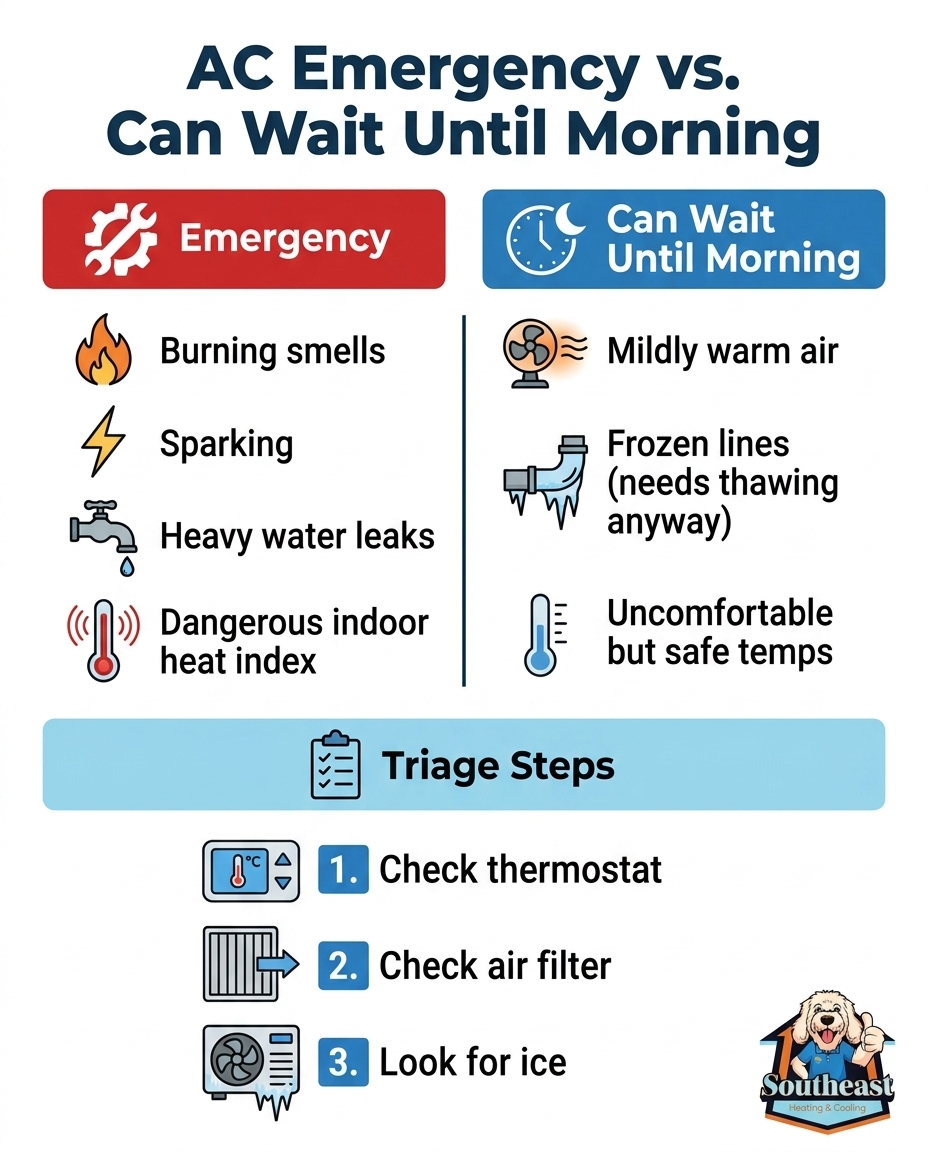
If you notice any of the following red flags, turn your system off at the thermostat and seek immediate professional help:
• Electrical burning smells: An odor resembling melting plastic, burning wires, or ozone indicates a serious electrical fault that could lead to a fire.
• Sparking or smoke: Any visible sparks or smoke coming from the indoor air handler or the outdoor compressor requires you to shut off the breaker immediately.
• Repeatedly tripping breakers: If your air conditioner trips the circuit breaker, you can reset it once. If it trips a second time, leave it off. Forcing the system to run can destroy the compressor or cause an electrical fire.
• Significant water leaks: A clogged condensate drain line can back up and dump gallons of water into your attic or utility closet, destroying floors and ceilings.
• Dangerous indoor heat indexes: The CDC warns that high indoor temperatures combined with high humidity can be dangerous, especially for vulnerable populations like infants, the elderly, or those with certain medical conditions.
Safe Triage Steps Before Requesting 24 Hour Air Conditioning Service Near Me
Before you assume the worst and make a costly emergency call, there are a few safe, non-technical steps you can take to troubleshoot the issue. Often, a 9 PM thermostat check reveals a problem that stems from a simple, easily correctable airflow restriction rather than a catastrophic mechanical failure. If you want to dive deeper into these symptoms, you can troubleshoot common AC issues through our online resources.
It is critical to remember that you should never attempt unlicensed electrical or mechanical repairs yourself. Opening panels, testing high-voltage wires, or handling refrigerant requires specialized training and certification. However, you can safely perform the following visual inspections to gather information for your technician.
1. Verify your thermostat settings: Someone in the house may have accidentally bumped the thermostat. Ensure the system is set to "cool" rather than "heat," and verify that the fan is set to "auto" rather than "on." If the fan is set to "on," it will blow warm air through the vents even when the cooling cycle is resting.
2. Inspect the indoor air filter: A severely clogged air filter starves the system of airflow. This causes the evaporator coil to drop below freezing, turning the ambient moisture into a block of ice. If your filter looks like a thick gray blanket, turn the system off and replace the filter.
3. Look for visible ice on the refrigerant lines: Check the copper lines running to your outdoor unit and the area around your indoor air handler. If you see white frost or solid ice building up, your system is frozen. Never attempt to touch, scrape, or melt the ice with a heat source. Simply turn the thermostat off, leave the fan on to help it thaw naturally, and wait for a professional.
4. Check the outdoor unit for obstructions: Ensure that leaves, branches, or outdoor furniture have not blocked the airflow around the outdoor condenser coil. The system needs clear space to exhaust the heat it removes from your home.
Signs Your AC Issue Can Safely Wait Until Morning
If you have ruled out electrical hazards, active water damage, and dangerous heat levels, you are likely dealing with a situation that can safely wait for normal business hours. During the late August back-to-school transition, losing your cooling is incredibly frustrating, but it does not always justify the premium cost of a 2 AM dispatch.
As your honest local advocate, we actively walk homeowners through over-the-phone triage to help them safely defer service and avoid unnecessary after-hours fees whenever possible. We believe in providing transparent guidance so you can make the best financial decision for your household. Once you verify that the situation is stable, you can confidently schedule a morning visit.
Mildly warm air without hazards: If the system is running but the air coming from the vents is room temperature, you likely have a refrigerant issue or a failing capacitor. As long as there are no burning smells, you can turn the system off at the thermostat and wait for daylight.
Uncomfortable but safe indoor temperatures: The Sleep Foundation notes that ideal sleeping temperatures are between 60 and 67 degrees. While a breakdown makes achieving this impossible, you can often bridge the gap safely using ceiling fans, portable box fans, and open windows if the outside air has cooled down enough.
The financial benefit of waiting: Emergency dispatch fees are higher because they require pulling a technician out of bed and paying overtime rates. If your family is healthy and your home is not actively sustaining water damage, turning off the system and waiting for a standard scheduled visit keeps more money in your pocket.
• Ozone or burning plastic smell — Immediate Action Required: Turn off system and breaker immediately — Service Recommendation: Emergency 24-Hour Dispatch
• Water leaking through ceiling — Immediate Action Required: Turn off system, clear area below — Service Recommendation: Emergency 24-Hour Dispatch
• System blowing room-temperature air — Immediate Action Required: Turn off system to prevent compressor damage — Service Recommendation: Wait for Morning Scheduled Visit
• Ice visible on copper refrigerant lines — Immediate Action Required: Turn thermostat OFF, turn fan ON to thaw — Service Recommendation: Wait for Morning Scheduled Visit
How Late Summer Humidity Impacts Your AC's Overnight Performance
To understand why air conditioners so frequently fail late at night during this specific time of year, you have to look at the regional climate. In Buford GA, late August frequently sees high overnight humidity levels that prevent homes from naturally cooling down after sunset. When the sun goes down, the ambient temperature might drop slightly, but the moisture in the air remains thick and oppressive.
The Burden of the Dehumidification Cycle
Your air conditioner does two jobs: it lowers the temperature (sensible heat) and it removes moisture from the air (latent heat). During periods of extreme humidity, the AC unit works overtime primarily to pull that heavy moisture out of your indoor air. This continuous, heavy workload increases the wear and tear on electrical components like capacitors and contactors.
This relentless cycle explains why a system that seemed perfectly fine at 5 PM might suddenly freeze up, blow a capacitor, or trip a breaker by 9 PM. The equipment simply runs out of endurance after battling the humidity all afternoon and evening. Understanding this cycle helps you recognize whether your system is truly failing or if it is just temporarily overwhelmed by a clogged filter and a suffocating heat index.
Why an Honest Assessment Matters for Late-Summer AC Failures
Late-night panic can easily lead to hasty, expensive decisions. When you are sweating through the late August back-to-school transition and a technician arrives at 2 AM, it is easy to feel pressured. Some contractors use this late-night vulnerability to push for an immediate, costly system replacement, claiming the unit is beyond repair.
However, a proper diagnostic performed in the daylight often reveals a much simpler, more affordable fix. A system that shuts down completely might just need a new indoor motherboard, a replacement capacitor, or a cleared drain line. Getting a second opinion is crucial if a late-night technician condemns an older system without performing thorough, step-by-step electrical testing.
A typical pattern we see involves older systems being prematurely condemned during high-stress weather events. In one instance earlier this year, a homeowner was told by another company that their 13-year-old system required a total replacement. We provided a second opinion, evaluated the equipment thoroughly, and found that the core components were still functional. We simply replaced the indoor motherboard and performed standard maintenance. This honest assessment restored their cooling functionality completely and saved them from an unnecessary, high-cost replacement.
Frequently Asked Questions About Late-Night AC Failures
What actually constitutes an AC emergency?
An AC emergency involves electrical burning smells, sparking, significant water leaks, or indoor temperatures reaching unsafe levels for vulnerable individuals. If you smell melting plastic or see water actively damaging your ceiling, you need to shut the system down and call for immediate dispatch. These situations pose a direct threat to your safety and your property. If these hazards are absent, the issue can typically wait until normal business hours.
Is an AC blowing warm air an emergency?
Not usually, unless it is accompanied by electrical issues or extreme indoor heat indexes that threaten your family's health. While it is highly uncomfortable, a system blowing warm air usually indicates a failed capacitor or a refrigerant leak. It is typically safe to turn the system off at the thermostat to protect the compressor and wait for a morning diagnostic visit.
Can I sleep in a house with no AC?
Yes, provided the indoor temperature and humidity remain at medically safe levels for everyone in your household. You can manage the discomfort by using ceiling fans, setting up portable fans to create a cross-breeze, and staying hydrated. If the outdoor temperature drops overnight, opening windows can help bridge the gap until a technician arrives the next day.
Is a frozen AC line an emergency?
No, a frozen AC line actually requires the system to be turned off to thaw completely before a technician can properly diagnose it. A professional cannot accurately test refrigerant pressures or inspect a coil that is encased in solid ice. Turn the thermostat off, leave the fan setting on "on" to circulate warm air over the ice, and schedule a morning visit.
What should I do if my AC stops working at night?
First, check the thermostat settings and inspect the air filter for severe clogs. If the filter is clean and the settings are correct, turn the system off if it is blowing warm air or making strange noises. Finally, call a trusted local provider for phone triage to determine if the symptoms require an immediate visit or if you can safely wait.
How does overnight humidity affect my indoor heat index?
High humidity prevents your body's sweat from evaporating, making the indoor air feel significantly hotter and more dangerous than the actual temperature reading on the wall. When the AC fails, the loss of dehumidification causes the indoor heat index to spike rapidly. This is why a 9 PM thermostat check in late August can feel so suffocating even if the sun went down hours ago.
Get Honest AC Guidance When You Need It Most
You do not have to navigate a late-night cooling failure alone, and you certainly do not have to guess what actually constitutes an AC emergency in August (and when it can wait until morning). If you are staring at a rising thermostat in Buford GA and feeling the panic set in, reach out for an honest phone triage assessment. We will help you evaluate the symptoms, prioritize your family's safety, and determine the most cost-effective path forward. To prevent these late-night panics from happening in the first place, consider enrolling in a routine AC maintenance plan to keep your system running smoothly all season long.
Related Blogs
Customer Testimonials


Financing




Latest Blogs

Identifying Hidden Duct Leaks After a Summer of High Georgia Humidity
What Actually Constitutes an AC Emergency in August (And When It Can Wait Until Morning)
.avif)
Reliable HVAC Services in Buford, GA | Southeast Cooling & Heat