

 Blogs
BlogsRepairing a Leaking AC Coil in September vs. Holding Out for a Winter Heat Pump Replacement
Facing a Late-Season Breakdown: The Fall HVAC Dilemma
Are you staring at a central air conditioning unit that is constantly freezing over or blowing lukewarm air right as the seasons begin to change, forcing you to weigh the difficult choice of Repairing a Leaking AC Coil in September vs. Holding Out for a Winter Heat Pump Replacement? At Southeast Heating & Cooling, we see this highly specific, incredibly frustrating situation frequently as summer winds down. You are caught in a transitional period where the weather is shifting, but your indoor comfort is suddenly compromised.
During the September transition in Georgia, the weather presents a unique challenge. The evening temperatures might finally be starting to cool down, offering a brief respite from the sweltering summer heat, but the lingering high humidity of the Southeast remains in full force. When your air conditioner fails during this time, your home does not just get warm—it becomes sticky, stagnant, and deeply uncomfortable. A functional cooling system is still absolutely essential to remove that oppressive indoor moisture, even if the thermometer outside is reading a few degrees lower than it did in July.
This leaves you facing a significant household decision. Do you sink money into a temporary fix just to survive the final warm weeks of the year, or do you manage the discomfort strategically and plan for a comprehensive system upgrade during the slower off-season? If you are looking for immediate air conditioning repair services to restore your comfort today, or you want to start planning a permanent heat pump replacement, our team believes that understanding the mechanics of your failing system is the first step toward making the right choice.
The Harsh Reality of a Leaking Evaporator Coil
To make an informed decision about your HVAC system, you first need to understand exactly what is happening inside the equipment when a coil begins to fail. The evaporator coil is a critical component located inside your home, usually attached to your furnace or air handler. Its primary job is to absorb heat and extract humidity from the indoor air as warm air is blown across its chilled metallic surface.
How the Evaporator Coil Functions
Inside that coil, chemical refrigerant circulates, changing from a liquid to a gas as it absorbs heat. When this closed-loop system is fully pressurized and intact, the process works flawlessly. The coil remains cold, condensation forms on the outside of the metal fins (which drains away, removing humidity from your home), and chilled air is pushed through your ductwork. However, when the copper or aluminum tubing develops microscopic holes due to corrosion, vibration, or age, that pressurized refrigerant begins to escape into the atmosphere.
Recognizing the Symptoms of a Refrigerant Leak
A leaking evaporator coil will quickly disrupt the delicate balance of pressure and temperature required for your system to function. In our experience servicing homes throughout Buford, you will typically notice a progression of warning signs:
1. Loss of Cooling Power: The system runs continuously, but the air coming out of the vents feels room-temperature or only slightly cool.
2. Elevated Indoor Humidity: Because the coil is no longer cold enough to pull condensation out of the air, your home begins to feel clammy and sticky.
3. Ice Buildup: Counterintuitively, a lack of refrigerant causes the temperature of the coil to drop below freezing. The moisture in the air freezes instantly upon contact, encasing the indoor unit and the exterior refrigerant lines in solid ice.
4. Hissing or Bubbling Sounds: In cases of severe leaks, you might actually hear the pressurized refrigerant escaping from the indoor unit.
The "Top-Off" Myth and Regulatory Realities
One of the most persistent misconceptions our technicians encounter in the field is that an air conditioner simply "uses up" its refrigerant over time and occasionally needs a recharge. This is entirely false. An air conditioner is a sealed system. If the refrigerant level is low, it means there is a physical leak that must be addressed. Simply adding more refrigerant without fixing the underlying hole is like trying to inflate a punctured tire without patching it first.
Furthermore, EPA regulations regarding older, phased-out refrigerants make repeatedly topping off an aging system increasingly impractical. As older chemical refrigerants are phased out of production due to their environmental impact, the remaining supplies become heavily restricted. Continually recharging a leaking system is not only environmentally irresponsible, but it is an unsustainable strategy that will eventually force your hand. When dealing with late-season AC emergencies, understanding that a low charge always indicates a physical failure is crucial to evaluating your next steps.
The Band-Aid Approach: Pros and Cons of a Late-Season Repair
When you are sweating in your living room during the September transition in Georgia, the fastest route to relief is often the most tempting. In our years of servicing HVAC systems in Buford, we find that repairing a leaking evaporator coil—or simply paying a technician to add refrigerant to get the system cooling again—is a common band-aid approach. However, this strategy comes with significant long-term drawbacks that must be weighed against the short-term benefits.
The Problem: Immediate Discomfort
The primary driver for a late-season repair is the immediate need for comfort. You want the humidity gone, and you want to sleep comfortably through the night. Choosing to fix the immediate leak or recharge the system provides a rapid restoration of cooling power for the remainder of the warm season. For a few weeks, your home will feel normal again, and the immediate crisis will seem resolved.
The Cause: The Sunk-Cost Fallacy
The danger of the band-aid approach lies in the sunk-cost fallacy. When you invest heavily into a failing, aging system just to get through a few more weeks of use, you are sinking funds into obsolete equipment. An evaporator coil replacement is a major, labor-intensive repair. If the outdoor compressor is also nearing the end of its lifespan, you are replacing half of a mismatched system. You spend a significant amount of resources to revive a unit that is still highly likely to experience a catastrophic failure in a different component next summer.
The Solution: Evaluating the Risk of Recurring Leaks
If you opt for a simple refrigerant top-off instead of a full coil replacement, our technicians warn that you face an extremely high probability that the system will simply leak again before the next cooling season arrives. Microscopic leaks in copper coils rarely stay microscopic; the constant pressure and temperature fluctuations cause the holes to expand. By the time you turn your air conditioner back on next spring, the system will likely be empty again, leaving you right back where you started.
Sinking funds into a temporary fix diverts valuable resources away from a permanent, highly efficient solution. For homeowners in Buford GA, where the cooling season is long and demanding, relying on a compromised system is a gamble that rarely pays off in the long run.
The Long-Term Strategy: Why Winter is Ideal for Upgrades
If you can manage to bridge the gap through the final warm days of fall, holding out for a strategic system replacement during the slower winter months offers tremendous advantages. Our team at Southeast Heating & Cooling frequently points out that transitioning away from a failing traditional air conditioner to a modern, high-efficiency heat pump is one of the smartest investments you can make in your home's infrastructure.
How Modern Heat Pumps Revolutionize Comfort
Unlike traditional furnaces that burn fossil fuels to generate heat, modern air-source heat pumps function by moving heat from one place to another. During the summer, they act exactly like a high-performance air conditioner, extracting heat from your home and dumping it outside. During the winter, a reversing valve switches the flow of refrigerant. The system absorbs ambient heat energy from the outdoor air—even when it feels cold to the human touch—and transfers that heat inside to warm your living space.
Why Mild Winters are the Perfect Match
The regional climate plays a massive role in the effectiveness of this technology. Georgia's mild winters, which rarely sustain deep freezes for extended periods, are perfectly suited for heat pump technology. Because the outdoor temperatures generally remain moderate, the heat pump has an abundance of ambient heat energy to draw from. This mild winter climate provides the optimal operating range for maximum heat pump efficiency, allowing the system to heat your home using a fraction of the electricity required by traditional electric resistance heaters.
Strategic Timing and Financial Incentives
Planning an upgrade during the slower off-season months provides a strategic benefit that cannot be overstated. When you wait for winter, you avoid the rushed, chaotic environment of peak-season emergency installations. HVAC technicians have more flexible schedules, allowing for meticulous, unhurried installation work—which is a factor we consider to be the most important element in the longevity of any new HVAC system. You can often take advantage of off-season installation discounts as companies look to keep their crews busy during the slower months.
Additionally, modernizing your home with a high-efficiency heat pump often qualifies you for generic federal tax credits and local utility rebates. While specific programs and availability vary, taking the time to research these incentives during the off-season can significantly improve the long-term return on investment, offsetting the initial installation costs and making the upgrade highly advantageous.
Side-by-Side Comparison: Late-Season Repair vs. Off-Season Replacement
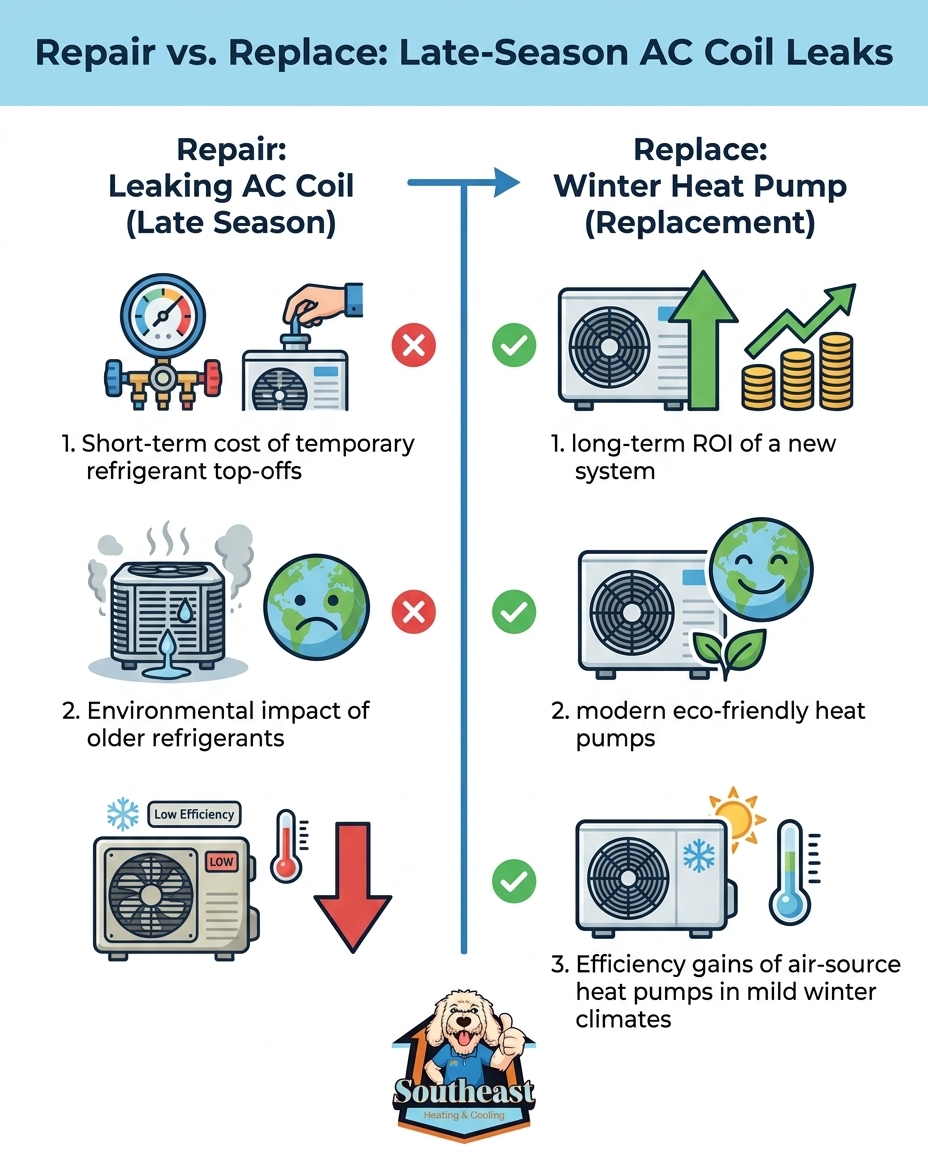
To help clarify this complex decision, it is helpful to look at the two options objectively. When facing a coil leak during the September transition in Georgia, you must evaluate the short-term relief against the long-term benefits. The following breakdown compares the reality of limping an old system along versus investing in modern technology.
• Immediate Timeline — Late-Season Coil Repair / Top-Off: Fast, temporary band-aid to restore immediate cooling for the final weeks of fall. — Off-Season Heat Pump Upgrade: Requires patience and temporary comfort management until a scheduled winter installation.
• Long-Term Reliability — Late-Season Coil Repair / Top-Off: High risk of recurring leaks; older components remain prone to sudden failure. — Off-Season Heat Pump Upgrade: Exceptional peace of mind backed by comprehensive new system warranties.
• Environmental Impact — Late-Season Coil Repair / Top-Off: Relies on leaking older refrigerants that are being phased out by the EPA. — Off-Season Heat Pump Upgrade: Utilizes eco-friendly modern refrigerants in a fully sealed, highly efficient system.
• Overall Efficiency — Late-Season Coil Repair / Top-Off: Limping an old AC along results in high energy bills and poor humidity control. — Off-Season Heat Pump Upgrade: Delivers up to three times more heat energy than the electrical energy it consumes.
Bridging the Gap: Managing Comfort Until Your Upgrade
If you decide that holding out for a winter heat pump installation is the smartest long-term move for your home, you still have to survive the lingering heat and humidity of early fall. Fortunately, there are several practical, actionable strategies you can employ to manage your indoor comfort while your failing AC system limps across the finish line.
Implementing these techniques can help you maintain a tolerable environment in your Buford GA home without putting undue stress on a compromised evaporator coil:
• Utilize ceiling fans strategically: Ceiling fans do not lower the temperature of a room, but they create a wind-chill effect on your skin. This allows you to set your thermostat a few degrees higher—reducing the workload on your leaking AC—without sacrificing your personal comfort.
• Block out solar heat gain: The sun beating through your windows forces your AC to work significantly harder. Keep blinds, shades, and curtains tightly closed during the hottest parts of the afternoon, particularly on south and west-facing windows.
• Optimize your airflow: Ensure that all air vents and return grilles are completely unblocked by furniture or rugs. Furthermore, install a clean, fresh air filter to maximize whatever airflow the failing system can still produce, reducing static pressure and helping prevent the coil from freezing over completely.
• Explore bridge financing: You do not necessarily have to suffer in the heat while waiting to save up cash for an off-season install. Leveraging flexible financing options can serve as a bridge, making an early or off-season replacement financially feasible right now, allowing you to upgrade on your own terms.
Making the Right Call for Your Home's Long-Term Comfort
Dealing with an air conditioning breakdown is never convenient, but a late-season coil leak presents a unique opportunity to step back and make a smart, strategic upgrade for your home. While the immediate frustration is undeniable, taking the time to evaluate the severity of the leak against the timeline of falling autumn temperatures ensures that you are making a decision based on long-term value, rather than short-term panic.
Every home in Buford GA has unique cooling demands, ductwork configurations, and insulation levels. What makes sense for one property might not be the best path forward for another. That is why the team at Southeast Heating & Cooling is deeply committed to providing honest, no-pressure assessments and free second opinions based on our years of local experience. We believe in giving you all the facts about your system's condition so you can make the most cost-effective choice for your family.
Before you commit to a sunk-cost repair on an aging system, let our professionals evaluate the true state of your evaporator coil. By understanding your options and exploring the benefits of a modern heat pump upgrade, you can secure a clear, pragmatic framework to ensure your home remains comfortable, efficient, and reliable for years to come.
Frequently Asked Questions
Is it worth replacing an AC evaporator coil?
The short answer is that it depends heavily on the age and condition of the rest of your system. In our experience, if your air conditioner is relatively new and still under warranty, replacing a defective coil is absolutely worth it. However, if the unit is out of warranty, uses outdated refrigerant, and the outdoor compressor is also nearing the end of its life, replacing just the indoor coil is often a poor investment. You risk sinking funds into a system that may suffer another major failure shortly after.
Can you just add freon to a leaking AC?
While a technician can technically add refrigerant to a leaking system to restore cooling temporarily, it is never a permanent solution. An air conditioner is a sealed, pressurized system; if it is low on refrigerant, there is a physical hole that must be fixed. Continually topping off a leaking system is environmentally irresponsible, increasingly impractical due to EPA regulations, and ultimately a waste of money since the new refrigerant will simply leak out again.
Should I replace my AC with a heat pump?
For most homeowners in mild climates, replacing an aging AC with a heat pump is a highly strategic upgrade. A heat pump functions exactly like an air conditioner during the summer, but it can reverse its operation to provide highly efficient heating during the winter. This dual functionality allows you to consolidate your heating and cooling into one advanced system, often resulting in lower year-round utility bills and improved indoor comfort.
Are heat pumps good for Georgia winters?
Yes, modern air-source heat pumps are exceptionally well-suited for the winter climate in Georgia. Because the region experiences mild winters and rarely sustains deep, prolonged freezes, there is an abundance of ambient heat energy in the outdoor air for the system to extract. Heat pumps operate at peak efficiency in these moderate conditions, delivering reliable, consistent warmth without the high energy costs associated with traditional electric resistance heating.
How long can an AC run with a leaking evaporator coil?
An air conditioner with a leaking coil can run anywhere from a few days to a few months, depending entirely on the size and severity of the leak. A microscopic pinhole leak might allow the system to limp along for an entire season before the charge drops low enough to cause the coil to freeze. Conversely, a major structural failure in the coil can vent all the refrigerant in a matter of hours, causing an immediate and total loss of cooling power.
What are the signs that my AC refrigerant is leaking?
The most common signs of a refrigerant leak include a noticeable drop in cooling power, where the air from your vents feels lukewarm instead of crisp and cold. You will likely experience elevated indoor humidity as the system loses its ability to dehumidify the air. Additionally, you may see solid ice forming on the indoor evaporator coil or the outdoor copper refrigerant lines, and in severe cases, you might hear a faint hissing or bubbling sound coming from the unit.
Related Blogs
Customer Testimonials


Financing



Latest Blogs

Navigating 24-Hour Furnace Emergencies: What Justifies a Midnight Call in Buford
Why Your Heat Pump Is Vibrating During the Fall Startup (And When to Call a Pro)
Repairing a Leaking AC Coil in September vs. Holding Out for a Winter Heat Pump Replacement