


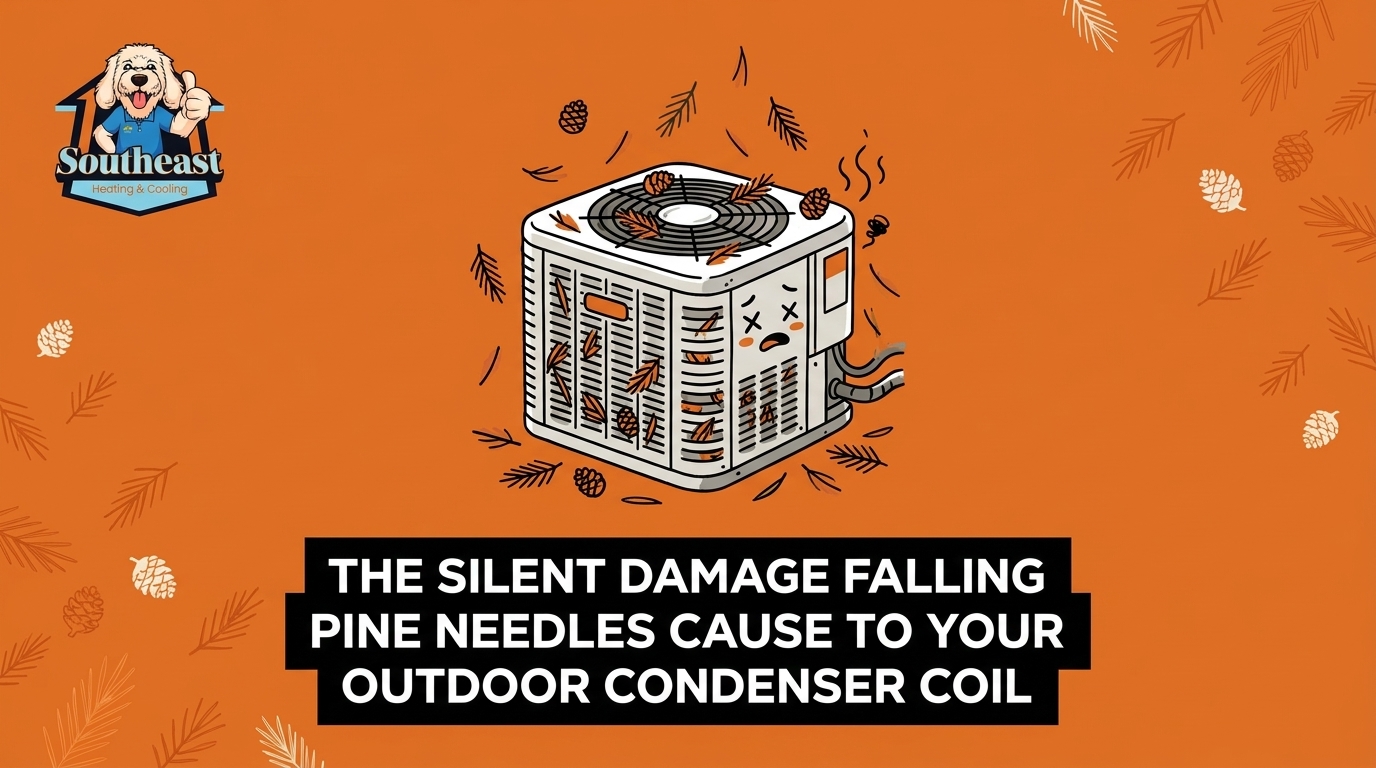
The Silent Damage Falling Pine Needles Cause to Your Outdoor Condenser Coil
When Autumn Drops a Hidden Threat on Your HVAC System
By the time October and mid-fall weather arrives in North Georgia, you might be enjoying the cooler temperatures, completely unaware of the silent damage falling pine needles cause to your outdoor condenser coil. At Southeast Heating & Cooling, our technicians see this hidden threat suffocating systems year after year. As the foliage begins to shed rapidly, your outdoor heat pump or air conditioner becomes highly vulnerable to fine, wind-blown debris. While large oak and maple leaves are easy to spot and clear away, the real danger is much smaller and far more insidious. Homeowners frequently assume their equipment is clean simply because the exterior metal casing looks clear from the yard. In reality, a pattern we see often is a dense mat of organic material secretly building up inside the cabinet, preparing to suffocate your system just as the winter heating season begins.
To protect your equipment from this hidden seasonal threat, maintaining your air conditioning systems requires a proactive HVAC maintenance plan that goes far beyond a superficial wipe-down of the exterior panels.
The transition from summer cooling to winter heating is the most critical time for your outdoor unit. Throughout the long, hot summer, the condenser fan has been pulling thousands of cubic feet of air through the side panels to exhaust heat. As the season changes, that powerful suction begins pulling in autumn debris. The dilemma most homeowners face is deciding whether a quick sweep around the unit is enough, or if the internal components require professional attention. Understanding exactly how this debris interacts with the fragile internal mechanics of your system is the first step in preventing an expensive mid-winter breakdown.
How Fine Needles Bypass Standard Condenser Guards
There is a significant mechanical difference between how broad autumn leaves and fine pine needles interact with your outdoor HVAC equipment. Broad leaves largely bounce off the outer grilles or sit harmlessly on top of the fan guard. They are easily visible and can be swept away with a broom. Pine needles, however, are aerodynamically shaped to slip right past these initial defenses. Wooded areas in North Georgia, particularly Buford GA wooded neighborhoods, are heavily populated with Loblolly and Virginia pines. In our experience servicing these local communities, we find that these specific trees shed a massive volume of fine, flexible needles every autumn, making this a highly localized and recurring issue for our customers.
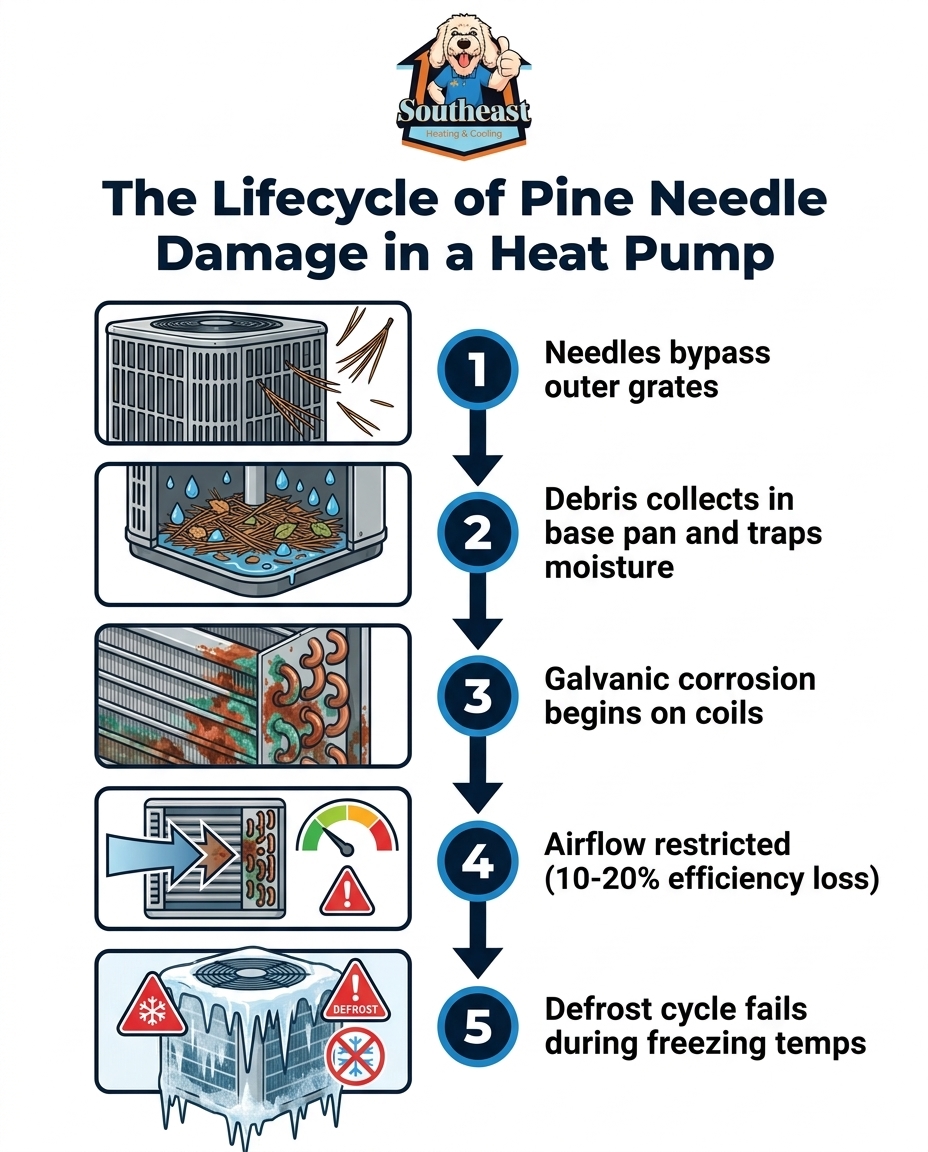
Once these needles fall, their slender shape allows them to slide vertically through standard louvered guards. They bypass the metal exterior and drop directly into the base pan of the unit. Over weeks of continuous shedding, these needles slowly build a dense, compacted layer at the bottom of the cabinet. This internal accumulation often mirrors how clogged condensate drains affect performance—the problem develops completely out of sight until the system eventually chokes and shuts down.
• Broad Leaves (Oak, Maple) — Interaction with HVAC Exterior: Blocks exterior louvers, easily visible — Internal Accumulation Risk: Low (too large to pass through grilles) — Impact on Airflow: Temporary surface restriction
• Pine Needles (Loblolly, Virginia) — Interaction with HVAC Exterior: Slips vertically through metal guards — Internal Accumulation Risk: High (collects in base pan and lower coils) — Impact on Airflow: Severe internal blockage and moisture retention
• Grass Clippings — Interaction with HVAC Exterior: Sticks to exterior fins if wet — Internal Accumulation Risk: Moderate (pulled through if dry and fine) — Impact on Airflow: Surface matting on exterior coils
The Deceptive Appearance of a 'Clean' Exterior
Visual inspections from the yard are incredibly misleading during the fall season. Our service technicians frequently visit homes where the homeowner looked at their outdoor unit, saw clear metal louvers, and assumed the system was perfectly fine. However, the condenser fan creates a powerful vacuum effect. While the system is running, this suction actively pulls lightweight needles deeper into the cabinet, lodging them tightly between the delicate aluminum coil fins. Because the needles are pulled inward, the exterior of the unit remains looking pristine while the interior airflow pathways become completely obstructed.
The hidden danger: The lower third of your outdoor coil is usually the first to succumb to this blockage. As the needles pile up in the base pan, they begin to cover the bottom rows of the heat transfer fins. This forces the upper portion of the coil to work twice as hard to move the same amount of air, increasing wear and tear on the compressor motor long before any obvious symptoms appear inside your home.
Moisture Traps and the Acceleration of Coil Corrosion
Pine needles do not just block airflow; they introduce a severe chemical and physical degradation risk to the internal components of your condenser cabinet. By October and mid-fall, the combination of morning dew, seasonal rain, and falling debris creates the perfect environment for rapid decomposition. As pine needles break down at the bottom of the unit, they turn into a dense, acidic mulch. We regularly pull this sponge-like organic layer out of customer units, where it has been trapping moisture against the sensitive metal components of the HVAC system long after the rain has stopped and the surrounding yard has dried.
This trapped moisture is disastrous for your equipment. ASHRAE (The American Society of Heating, Refrigerating and Air-Conditioning Engineers) guidelines strictly warn against coil fouling, noting the high risk of galvanic corrosion on aluminum and copper condenser coils. Galvanic corrosion occurs when dissimilar metals are exposed to an electrolyte—in this case, the acidic, moisture-laden mulch created by rotting pine needles.
The stages of silent degradation inside your cabinet:
• Initial accumulation: Dry needles gather in the base pan, blocking the drainage holes designed to let rainwater escape.
• Moisture retention: The clogged base pan holds standing water, soaking the accumulated needles and starting the decomposition process.
• Acidic mulching: As the pine needles rot, they release weak organic acids that sit directly against the copper tubing and aluminum fins.
• Galvanic corrosion: The acidic moisture facilitates an electrochemical reaction between the copper and aluminum, slowly eating away at the metal over weeks and months.
• Refrigerant leaks: If left unchecked, the corrosion eventually weakens the copper tubing enough to create microscopic pinhole leaks, allowing expensive refrigerant to escape into the atmosphere.
This chemical degradation happens completely silently. You will not hear it, and you will not see it from the outside. By the time a homeowner calls us noticing a drop in heating performance due to low refrigerant, the structural damage to the outdoor coil is often already permanent and irreversible.
Suffocating Your Heat Pump's Crucial Defrost Cycle
The autumn debris problem connects directly to your winter heating performance, specifically threatening your system's ability to survive freezing temperatures. If you rely on a heat pump to warm your home, the outdoor unit must continually absorb ambient heat from the outside air and transfer it indoors. During cold weather, the moisture in the outdoor air naturally freezes onto the exterior coils. To prevent the unit from turning into a solid block of ice, the system relies on a crucial mechanism known as the defrost cycle.
Understanding heat pump operation during the winter reveals why airflow is so critical. When the system detects frost buildup, it temporarily reverses its operation. It sends hot refrigerant back to the outdoor coil to melt the ice, while the outdoor fan shuts off to allow the heat to build up. Once the ice melts, the fan turns back on, and normal heating resumes. However, compacted pine needles severely restrict the necessary airflow and insulate the lower coils, preventing the unit from effectively melting the frost.
According to Department of Energy (DOE) data, restricted airflow from dirty coils and debris can cause a 10% to 20% loss in overall system efficiency. When peak needle drop aligns directly with the arrival of freezing early-winter nights in Georgia, it creates a perfect storm for total system failure in Buford GA wooded neighborhoods.
The Chain Reaction of Restricted Airflow
When pine needles suffocate the cabinet, the defrost cycle cannot function properly. This triggers a rapid sequence of failures:
1. Needles block the lower coil fins: The thick mat of debris prevents ambient air from passing through the bottom half of the unit, reducing the surface area available for heat transfer.
2. The compressor works harder: Struggling to pull enough air to operate efficiently, the compressor runs longer and hotter, significantly increasing mechanical wear and driving up your monthly energy bills.
3. The system fails to trigger or complete defrost mode: Because the sensors are insulated by wet debris or the airflow is too restricted to clear the melted water, the frost continues to build.
4. Ice buildup consumes the unit: The thin layer of frost rapidly thickens into solid ice, encasing the fan blades and coils. The system will eventually lock out completely, leaving your family without heat during the coldest nights of the year.
Why Surface Wiping Is Never Enough
When faced with an accumulation of autumn debris, many homeowners attempt to solve the problem themselves. Clearing two feet of space around the unit and brushing off the top is excellent practice and highly recommended. Keeping surrounding shrubs trimmed and removing broad leaves from the exterior will help maintain general airflow. However, these surface-level actions do absolutely nothing to solve the internal buildup of pine needles.
The garden hose mistake: A common piece of generic advice is to spray the outside of the unit with a garden hose to clear away dust and debris. We strongly advise our customers against this. If your cabinet is filled with October and mid-fall pine needles, doing this is one of the worst things you can do. Spraying water directly into the exterior louvers simply pushes the fine needles deeper into the delicate aluminum coil fins, wedging them tighter. It also adds more moisture to the acidic mulch already rotting in the base pan, accelerating the corrosion process.
You should strictly avoid opening the condenser cabinet or attempting to clean the interior coils as a do-it-yourself project. The risks are substantial:
• High-voltage dangers: The outdoor unit houses a dual run capacitor that stores a lethal electrical charge, even after the power is disconnected at the breaker. Touching the wrong terminal can result in severe injury.
• Fragile aluminum fins: The heat transfer fins on the condenser coil are incredibly thin—often no thicker than a few sheets of heavy foil. Brushing them with a standard broom, a shop vacuum attachment, or your fingers will easily bend and crush them, permanently restricting airflow and ruining the coil.
• Specialized chemical requirements: Removing compacted, acidic organic matter safely requires specialized, non-acidic foaming coil cleaners that lift the debris out of the fins without damaging the delicate metal beneath.
Safely removing compacted organic matter requires specialized tools, professional training, and a thorough understanding of the equipment's electrical systems. Attempting to bypass a professional cleaning often results in crushed fins, electrical hazards, or a false sense of security that leaves the core problem untouched.
Proactive Deep Cleaning for Winter Reliability
Positioning your HVAC system to survive the winter without unexpected breakdowns requires proactive intervention. A comprehensive pre-winter tune-up is the definitive solution to the pine needle threat, specifically designed to address the hidden internal buildup that surface wiping leaves behind.
Professional home heating services involve much more than just a quick visual inspection. When maintaining systems in Buford GA wooded neighborhoods, our team at Southeast Heating & Cooling acts as your proactive local experts who actually look inside the cabinet to prevent winter freeze-ups. Rather than just doing a superficial exterior wipe-down, our true deep clean involves safely dismantling the outer casing to access the system's vulnerable core.
What a professional interior deep clean entails:
• Isolating the power: Technicians safely discharge capacitors and ensure zero voltage is present before opening the cabinet.
• Clearing the base pan: All compacted pine needles, rotting mulch, and trapped moisture are manually removed from the bottom of the unit, and the drainage weep holes are cleared.
• Inside-out coil washing: Using specialized, low-pressure wands and foaming coil cleaners, technicians wash the delicate fins from the inside out. This pushes any embedded needles back out the way they came in, rather than driving them deeper.
• Defrost cycle verification: Once the unit is clean and reassembled, the technician forces the system into a defrost cycle to verify that the sensors, reversing valve, and fan relays are operating flawlessly.
Removing this hidden debris restores the lost 10% to 20% efficiency, ensuring your heat pump will not struggle to pull air during the coldest nights of the year. More importantly, it ensures the defrost cycle will operate flawlessly, melting away frost before it can accumulate into a solid block of ice. Catching these issues early prevents emergency breakdowns during the first major cold snap, providing the peace of mind that comes with knowing your system is genuinely prepared for freezing temperatures.
Frequently Asked Questions
Can pine needles damage a heat pump?
Yes, pine needles can cause severe damage to a heat pump by slipping through the outer guards and blocking internal airflow. This restriction forces the compressor to work harder, accelerates wear and tear, and creates an acidic mulch in the base pan that corrodes the metal coils over time.
Why is my heat pump freezing up in winter?
A heat pump usually freezes up in winter because restricted airflow prevents the system's defrost cycle from working correctly. When debris like compacted pine needles blocks the lower coils, the unit cannot absorb enough ambient heat to melt the frost, causing solid ice to quickly encase the fan and fins.
How do you remove pine needles from inside an AC unit?
Removing pine needles from inside the unit requires a professional to safely disconnect the high-voltage power, open the exterior cabinet, and clear the base pan by hand. Technicians then use specialized foaming cleaners and low-pressure water to wash the delicate fins from the inside out, preventing damage to the aluminum.
Should I cover my outdoor condenser unit to keep pine needles out?
You should never completely cover your outdoor heat pump if you intend to use it for winter heating, as it must pull in massive amounts of air to function. Even for AC-only units in the off-season, tightly wrapping the equipment traps ground moisture inside the cabinet, which accelerates rust and creates an inviting environment for rodents.
How often should I have my outdoor coil professionally cleaned if I live in a wooded area?
If you live in a heavily wooded area with a high volume of pine trees, you should have your outdoor coil professionally cleaned at least twice a year. Scheduling a deep cleaning in the spring before the cooling season and again in late fall ensures that seasonal debris does not suffocate the system or disrupt your winter defrost cycles.
Don't wait until the first freezing night to discover that your outdoor unit is choking on autumn debris. Understanding exactly how those tiny needles bypass the outer guards to impact your heat pump's defrost cycle is the key to preventing a mid-winter emergency. Schedule your professional pre-winter coil cleaning today to ensure your system is clear, efficient, and ready to keep your home warm all season long.
Related Blogs
Customer Testimonials


Financing


Latest Blogs

Decoding the Loud Clanking Sound When Your Gas Furnace First Ignites in October

The Truth About Closing Vents in Unused Guest Rooms to Save on Heating Costs
The Silent Damage Falling Pine Needles Cause to Your Outdoor Condenser Coil