


The Truth About Closing Vents in Unused Guest Rooms to Save on Heating Costs
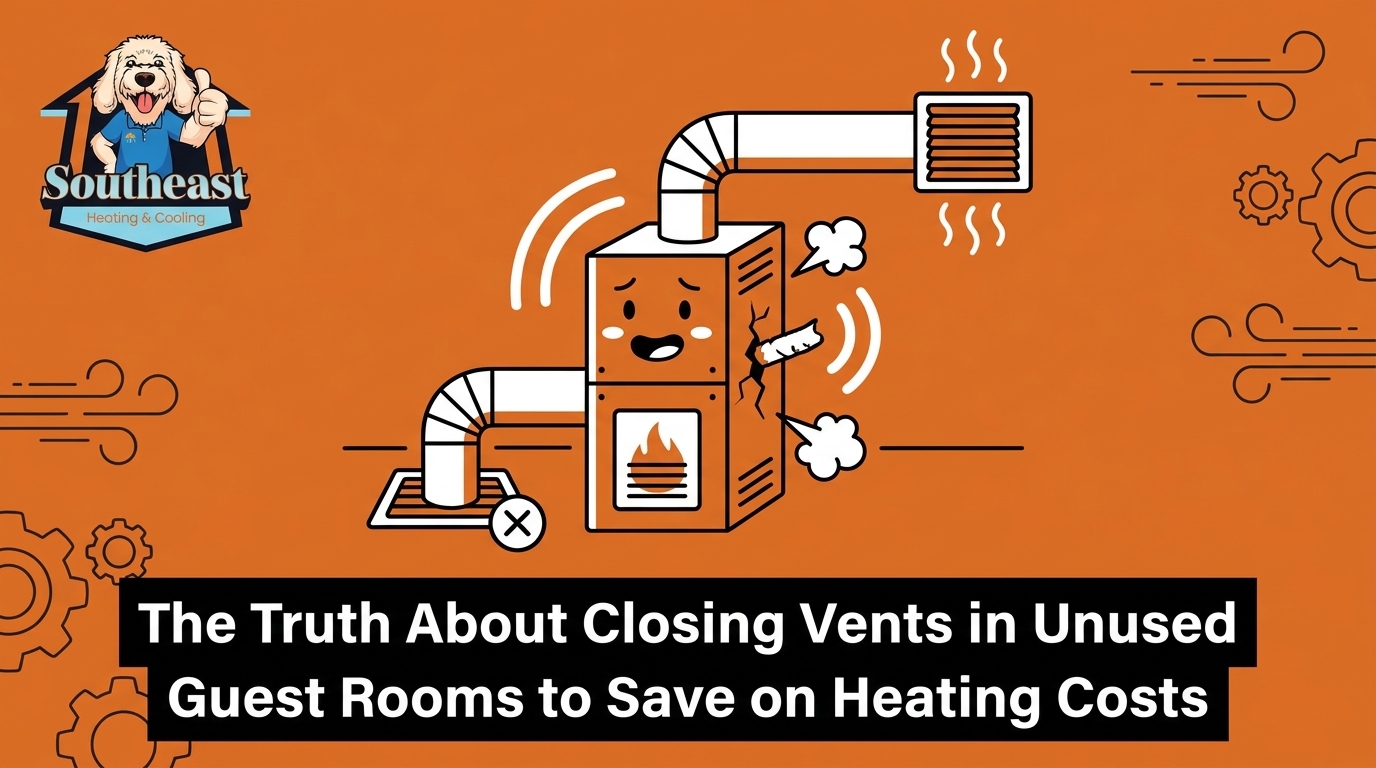
The Costly Temptation of Closing Vents Before Winter Arrives
Learning the truth about closing vents in unused guest rooms to save on heating costs reveals a surprising fact: this common practice doesn't lower your utility bills, but rather forces your equipment to work significantly harder. In our years of keeping Buford homes comfortable, the team at Southeast Heating & Cooling frequently sees homeowners attempt to lower their energy usage during the mid-fall heating startup by shutting off supply registers in spare bedrooms or empty offices. The logic seems perfectly sound on the surface. If a room is unoccupied, why pay to heat it? However, this decision point—how to manage airflow in unused spaces—often leads to inadvertent system strain that can cause severe mechanical damage over time.
As chilly Buford, GA winters approach and average temperatures drop into the 30s, the temptation to shut off unused rooms to cut heating bills becomes incredibly strong. It is completely understandable to want to minimize energy consumption as the weather cools. Unfortunately, modern residential heating systems are simply not designed to operate with restricted ductwork. When you close a vent, you are not telling the furnace to produce less heat; you are only blocking the path for the air it has already generated. This "saving" strategy actually triggers a cascade of negative mechanical consequences that end up costing far more in long-term repairs and premature equipment failure than any perceived monthly savings.
Why Shutting Guest Room Registers Doesn't Actually Save Energy
The problem: Homeowners often believe that shutting a register stops the furnace from consuming the fuel or electricity required to heat that specific room. The assumption is that the system will recognize the reduced demand and scale back its operation accordingly.
The cause: The fundamental misunderstanding lies in how forced-air systems actually consume energy. Furnaces and air handlers do not "know" when a vent is closed. They are not "smart" enough to detect a closed louver in a guest room and reduce their output. When the thermostat signals a call for heat, the system activates and produces the exact same volume of conditioned air, regardless of how many registers are open or closed. Energy consumption is tied directly to the blower motor's electrical draw and the length of time the burner or heating elements operate to satisfy the central thermostat.
The solution: To maintain efficiency, all vents must remain open to prevent high static pressure from building up inside the ductwork. Blocking a vent forces the exact same amount of air into a smaller distribution space. The system does not work smarter; it simply works harder to push air through a restricted pathway.
• The furnace produces less heat, saving fuel. — The Mechanical Reality: The furnace produces the exact same amount of heat, wasting energy.
• Air is perfectly redirected to rooms you use. — The Mechanical Reality: Air backs up in the ducts, causing severe high static pressure.
• The blower motor uses less electricity. — The Mechanical Reality: The blower motor strains against the resistance, drawing more amps.
Understanding the Physics of High Static Pressure in Forced-Air Systems
To fully grasp why closing vents is detrimental, it is necessary to understand the concept of static pressure. In residential HVAC applications, static pressure is the resistance to airflow within the ductwork. You can think of it as the blood pressure of your heating system. A certain amount of resistance is normal and expected, but when that resistance spikes artificially, the equipment struggles to perform its basic functions. Closing supply registers causes an immediate and severe spike in high static pressure.
Residential HVAC systems are precisely balanced for the home's total square footage. Engineers and installers calculate the exact volume of air needed to heat the home efficiently. When you close a vent, you disrupt this delicate balance. The blower motor is suddenly forced to push the same volume of air through fewer openings. The mechanical comparison is often described as trying to breathe heavily through a narrow drinking straw—your lungs have to work twice as hard to move the same amount of oxygen. The equipment struggles to push air through restricted pathways, leading to severe mechanical wear and tear over time.
How Ductwork is Sized for Your Home
Ducts are not just random metal tubes; they are mathematically sized based on the required CFM (Cubic Feet per Minute) of airflow. Every single branch, trunk line, and supply register is factored into a complex calculation known as Manual D duct design.
• Delicate Mathematical Balance: The system relies on a specific amount of air leaving the supply vents and returning through the return grilles.
• The Disruption of Closed Vents: Closing even one or two vents throws off this balance, reducing the total CFM the system can move.
• The Backpressure Effect: The air that cannot escape into the guest room bounces back into the main trunk line, increasing the overall resistance against the blower.
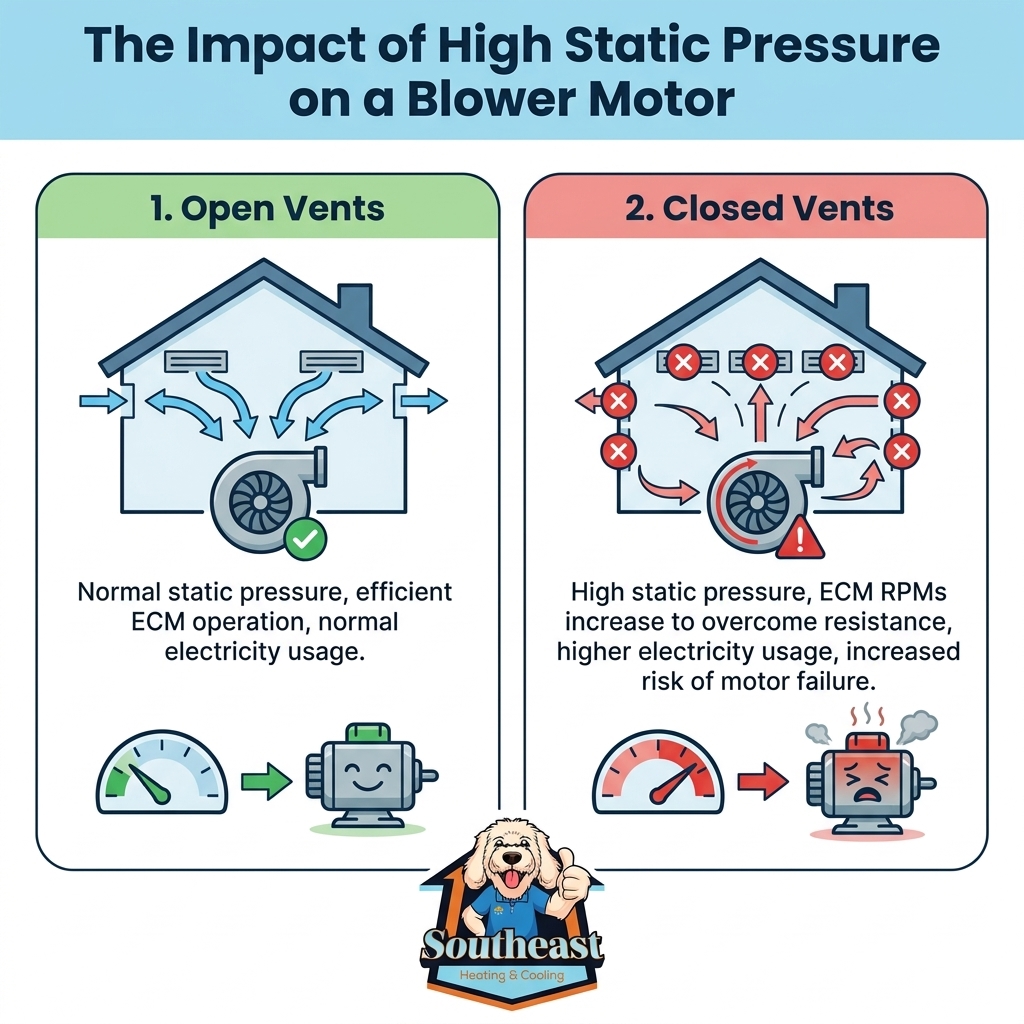
How Restricted Airflow Destroys Modern ECM Blower Motors
The problem: During the mid-fall heating startup, your HVAC equipment is already waking up from months of dormancy. Adding artificial strain to the system during this critical window is a recipe for sudden mechanical breakdowns, particularly concerning the system's blower motor.
The cause: Most contemporary furnaces and air handlers are equipped with an ECM (Electronically Commutated Motor). Unlike older, single-speed motors that simply push air at a constant rate, an ECM is designed to adjust its speed to maintain a specific, programmed airflow. When closed vents create high static pressure, the ECM senses the resistance. Its programming dictates that it must overcome this blockage to deliver the required CFM. To do this, the motor ramps up its RPMs, spinning faster and working significantly harder against the backpressure. This overexertion consumes drastically more electricity, entirely negating any perceived energy savings you hoped to achieve by closing the guest room door.
The solution: At Southeast Heating & Cooling, we prioritize honest, technical education because our technicians regularly replace burned-out ECM motors that were destroyed by closed vents. We explain these exact physics to empower homeowners, helping them avoid self-inflicted, costly blower motor repairs. By keeping all vents fully open, the ECM can operate at its lowest, most efficient speed. Prolonged strain from closed vents drastically shortens the blower motor's lifespan, leading to premature failure. If you are concerned about your system's performance, scheduling routine HVAC maintenance ensures your motor is operating within safe electrical parameters.
Heat Exchanger Risks and the Dangers of Overheating
The blower motor is not the only critical component threatened by restricted airflow. The heat exchanger—the metal core of your furnace where combustion heat is transferred to your breathing air—relies entirely on a consistent, robust flow of indoor air to keep it from overheating. When the blower motor pushes cool return air over the heat exchanger, it absorbs the thermal energy and safely carries it into your living spaces.
When high static pressure restricts this vital airflow, the heat generated by the burners has nowhere to go. The thermal energy builds up rapidly inside the furnace cabinet. Modern furnaces have safety mechanisms, such as high-limit switches, designed to shut the system down if it gets too hot. However, relying on a safety switch to constantly rescue your system from poor airflow is incredibly damaging. Repeated overheating cycles cause the metal heat exchanger to expand and contract far beyond its design limits.
Over time, this excessive thermal stress leads to metal fatigue and, eventually, stress cracks. A cracked heat exchanger is not just an expensive repair; it is a severe safety hazard. The heat exchanger separates the toxic combustion gases from the air circulating through your home. If it cracks, carbon monoxide and other exhaust gases can leak directly into your breathing air. Maintaining fully open supply registers is a critical safety measure to prevent this dangerous overheating scenario.
Duct Leakage and the Ripple Effect on Whole-Home Comfort
The problem: Closing vents in an unused room rarely results in a perfectly heated living room. Instead, during our pre-winter inspections, our team often hears homeowners complain that the rest of the house feels drafty, dusty, or unevenly heated despite the furnace running constantly.
The cause: High static pressure operates by the laws of physics; it always seeks the path of least resistance. When you block the primary exits (the supply registers), the pressurized air looks for alternative escape routes. In most residential duct systems, these escape routes are the tiny gaps, loose joints, and unsealed seams in the sheet metal or flex duct. The excessive pressure forces beautifully conditioned, expensive air out through these cracks and into unconditioned spaces like attics, basements, or crawlspaces. This phenomenon is known as duct leakage, and it represents a massive loss of energy.
The solution: Keeping the system balanced prevents this artificial pressurization. When the air can flow freely into the home, it doesn't try to force its way out into the attic. If you are already experiencing uneven temperatures, you might be dealing with poor airflow from your furnace vents caused by underlying duct issues, which closing registers will only make worse.
Impact on Indoor Breathing Air
The ripple effect of duct leakage goes beyond lost heat. It also impacts the air you breathe.
• Negative Pressure Zones: When forced air escapes into the attic, it creates pressure imbalances inside the living space.
• Drawing in Contaminants: To replace the lost air, the home acts like a vacuum, pulling in unfiltered air, dust, and allergens from outside, from the garage, or from the crawlspace.
• Diminished Comfort: The result is diminished airflow to the rooms you actually want to heat, causing the system to run longer while simultaneously degrading your indoor air purity. Maintaining proper system balance is critical for overall air quality.
Safe Alternatives for Managing Temperatures in Unoccupied Rooms
If closing vents is harmful, how can you responsibly manage the temperature in an empty guest bedroom or storage space during the mid-fall heating startup? There are several safe, actionable alternatives that reduce thermal loss without artificially choking your HVAC equipment's designed airflow.
1. Keep Vents Unobstructed: Ensure that all supply and return vents are fully open and completely unobstructed. Do not place heavy furniture, thick rugs, or long curtains over the grilles. The system needs to "breathe" freely to maintain proper static pressure.
2. Improve Room Insulation Naturally: Use weatherstripping around the guest room windows and install heavy, thermal-lined curtains. Keeping the curtains closed traps a layer of insulating air against the cold glass, naturally reducing the room's heat loss without altering the HVAC system's mechanical airflow.
3. Keep the Interior Door Open: If privacy is not an issue, leaving the guest room door cracked open allows for better air circulation back to the central return grilles, helping the entire house maintain a more balanced ambient temperature.
4. Invest in HVAC Zoning: If you frequently have unused sections of your home, consider upgrading to a professionally installed HVAC zoning system. True zoning uses motorized dampers inside the ductwork, paired with bypass ducts or variable-speed equipment, to safely direct air where it is needed without spiking the static pressure.
5. Explore Decentralized Options: If customized temperature control is a high priority for specific, isolated spaces, explore decentralized heating and cooling options. Solutions like heat pump systems (specifically ductless mini-splits) allow you to heat or cool a single room independently without impacting the central ductwork's delicate balance.
Protect Your Heating Equipment with Smart Airflow Management
The most effective way to ensure a smooth, efficient mid-fall heating startup is to work with the physics of your home, not against them. Reiterate the golden rule of forced-air systems: leaving all vents fully open protects the blower motor from excessive strain and shields the heat exchanger from dangerous overheating cycles. Proper airflow is the absolute foundation of energy efficiency, system longevity, and whole-home comfort.
If you find yourself constantly battling uneven temperatures, drafty rooms, or high utility bills, our technicians at Southeast Heating & Cooling want you to know the solution is not to block off registers. Instead, encourage a holistic approach to your home's performance. Have your system's static pressure and ductwork professionally evaluated. A well-balanced system will not only heat your home more evenly but will also support better indoor air quality and extend the life of your expensive mechanical equipment. Protect your investment by letting your heating system breathe exactly as it was engineered to do.
Frequently Asked Questions
Does closing vents save money on heating?
No, closing vents does not save money on heating. Your furnace produces the exact same volume of heat regardless of how many registers are open. By closing a vent, you simply force the blower motor to work harder against increased resistance, which actually consumes more electricity and wastes energy through duct leakage.
Why shouldn't you close vents in unused rooms?
You shouldn't close vents because it disrupts the precise mathematical balance of your home's ductwork. Blocking airflow creates high static pressure, which acts like a physical blockage in the system. This pressure forces conditioned air out through tiny leaks in the ductwork into unconditioned spaces like attics, while simultaneously straining the blower motor.
Can closing vents damage a furnace?
Yes, closing vents can cause severe mechanical damage to a furnace. The restricted airflow prevents the heat exchanger from cooling down properly, leading to dangerous overheating cycles that can crack the metal. Additionally, the increased resistance causes modern ECM blower motors to overwork, leading to premature motor failure.
How many vents can I safely close in my house?
HVAC professionals strongly recommend keeping 100% of your supply and return vents fully open. Even closing one or two vents in a standard residential system can alter the static pressure enough to reduce efficiency. If you must restrict airflow for a brief, specific reason, never close more than 10% of the vents in your home.
Does closing vents redirect air to other rooms?
While it may feel like more air is coming out of the remaining open vents, you are actually creating a bottleneck. Instead of efficiently redirecting the air, the closed vent causes backpressure in the ductwork. This pressure forces a significant portion of the conditioned air out through tiny seams and gaps in the ducts before it ever reaches the rooms you want to heat.
What is HVAC static pressure and why does it matter?
HVAC static pressure is the measurement of resistance to airflow within your duct system. It matters because your furnace and air handler are engineered to operate within a very specific pressure range. When static pressure is too high—often caused by closed vents or dirty filters—the equipment struggles to push air, resulting in higher energy consumption and mechanical breakdowns.
Related Blogs
Customer Testimonials


Financing



Latest Blogs
Decoding the Loud Clanking Sound When Your Gas Furnace First Ignites in October
The Truth About Closing Vents in Unused Guest Rooms to Save on Heating Costs
The Silent Damage Falling Pine Needles Cause to Your Outdoor Condenser Coil