


Why We Recommend MERV 8 Over MERV 13 Filters for Older Buford Residential Systems
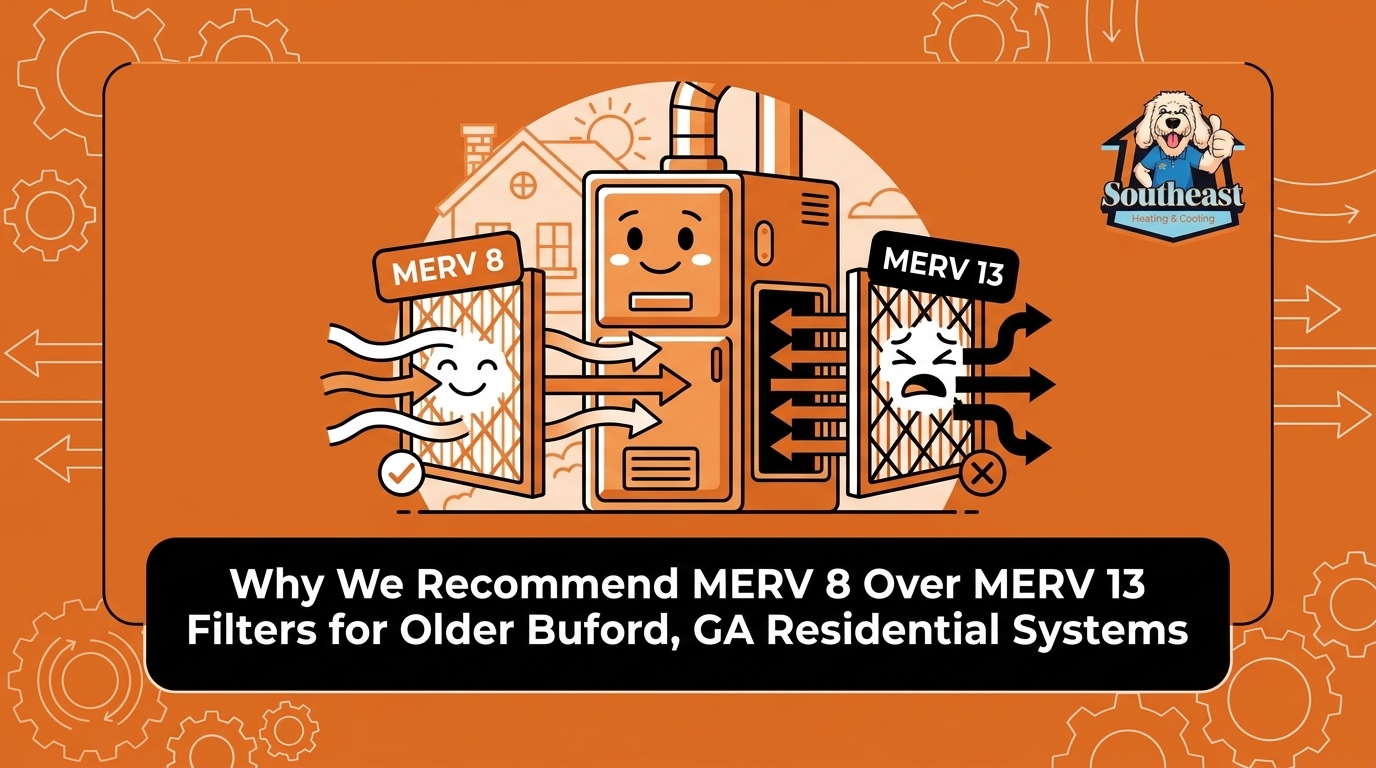
The Hardware Store Trap: Why Higher MERV Ratings Aren't Always Better
Buying the most expensive, highest-rated air filter on the hardware store shelf does not guarantee better air quality—in fact, it might be the exact thing that destroys your furnace. When homeowners ask why we recommend MERV 8 over MERV 13 filters for older Buford residential systems, the answer always comes down to the physics of airflow. Standing in the aisle of a big-box store, it is completely logical to assume that a higher number on the packaging translates to a healthier home. Retail marketing leans heavily into this, pushing MERV 13 as the ultimate upgrade to capture every microscopic particle floating through your living room.
However, what the packaging fails to mention is the mechanical toll these premium filters take on aging equipment. During the mid-fall pre-winter heating startup, homeowners frequently swap out their old filters for these dense, high-efficiency models, believing they are doing their system a favor. Instead, installing a MERV 13 filter in an older HVAC system inadvertently suffocates the blower motor. The system simply was not designed to pull air through such a restrictive barrier.
The concrete problem we see repeatedly is that this lack of airflow leads directly to frozen evaporator coils, overheating heat exchangers, and premature furnace failure. Before you invest in hospital-grade filtration that could compromise your equipment, it is critical to understand how your specific system breathes. By choosing a MERV 8 filter instead, you can maintain excellent indoor air quality while protecting the expensive components inside your furnace. If you are looking to upgrade your home's air without damaging your ductwork, exploring dedicated indoor air quality solutions is a much safer and more effective path than simply buying the thickest filter available.
Understanding the Trade-Off Between Filtration and Airflow
To understand why a higher rating isn't always better for your home, we have to look at how these ratings are determined. The American Society of Heating, Refrigerating and Air-Conditioning Engineers (ASHRAE) developed standard 52.2, which establishes the MERV rating system. MERV stands for Minimum Efficiency Reporting Value. This rating measures a filter's ability to capture airborne particles ranging in size from 0.3 to 10 microns. The scale typically runs from 1 to 16 for residential and commercial use.
The fundamental rule of air filtration is that as the MERV rating increases, the filter media must become denser to trap smaller particles. A MERV 8 filter uses a relatively open weave of synthetic fibers. It easily catches common household nuisances like pollen, dust mites, and pet dander. A MERV 13 filter, on the other hand, uses a tightly woven, densely packed media designed to trap microscopic particles like bacteria and smoke. While this sounds ideal, it creates a massive mechanical trade-off: a significantly higher pressure drop.
Pressure drop is the resistance that the filter creates against the airflow. Imagine trying to breathe normally through a standard paper medical mask, and then trying to take a deep breath through a thick wool blanket. Your lungs have to work much harder to pull air through the blanket. Your HVAC system experiences the exact same struggle. When analyzing the MERV 8 vs MERV 13 airflow restriction, the denser media of the MERV 13 filter makes it incredibly difficult for the system to pull in enough return air to function properly.
• MERV 1-4 — Typical Application: Basic window units — Primary Particles Captured: Large dust, lint, insects — Airflow Restriction Level: Very Low — System Compatibility: Almost all systems (but poor air quality)
• MERV 8 — Typical Application: Standard residential homes — Primary Particles Captured: Pollen, dust mites, pet dander — Airflow Restriction Level: Low to Moderate — System Compatibility: Excellent for older and modern systems
• MERV 11 — Typical Application: Homes with severe allergies — Primary Particles Captured: Lead dust, fine powders, auto emissions — Airflow Restriction Level: Moderate to High — System Compatibility: Requires modern blower motors
• MERV 13 — Typical Application: Hospitals, commercial buildings — Primary Particles Captured: Bacteria, virus carriers, smoke — Airflow Restriction Level: Very High — System Compatibility: Requires variable-speed ECM motors
Most MERV 8 filters are designed to provide the perfect residential balance—keeping the air clean while allowing the system to breathe freely. MERV 13 filters were originally designed for commercial environments, hospitals, and clean rooms where heavy-duty blower motors are specifically engineered to handle extreme airflow resistance. Forcing a commercial-grade filter into a standard residential return vent disrupts this delicate balance.
The Mechanical Reality: Static Pressure and Older Blower Motors
The core of this issue lies in a measurement called static pressure. In the HVAC world, static pressure is essentially the blood pressure of your ductwork. It measures the resistance to airflow within the system. Every component in your ductwork—from the bends in the sheet metal to the evaporator coil, and especially the air filter—adds to this resistance. Older residential heating units were engineered with very strict static pressure limits.
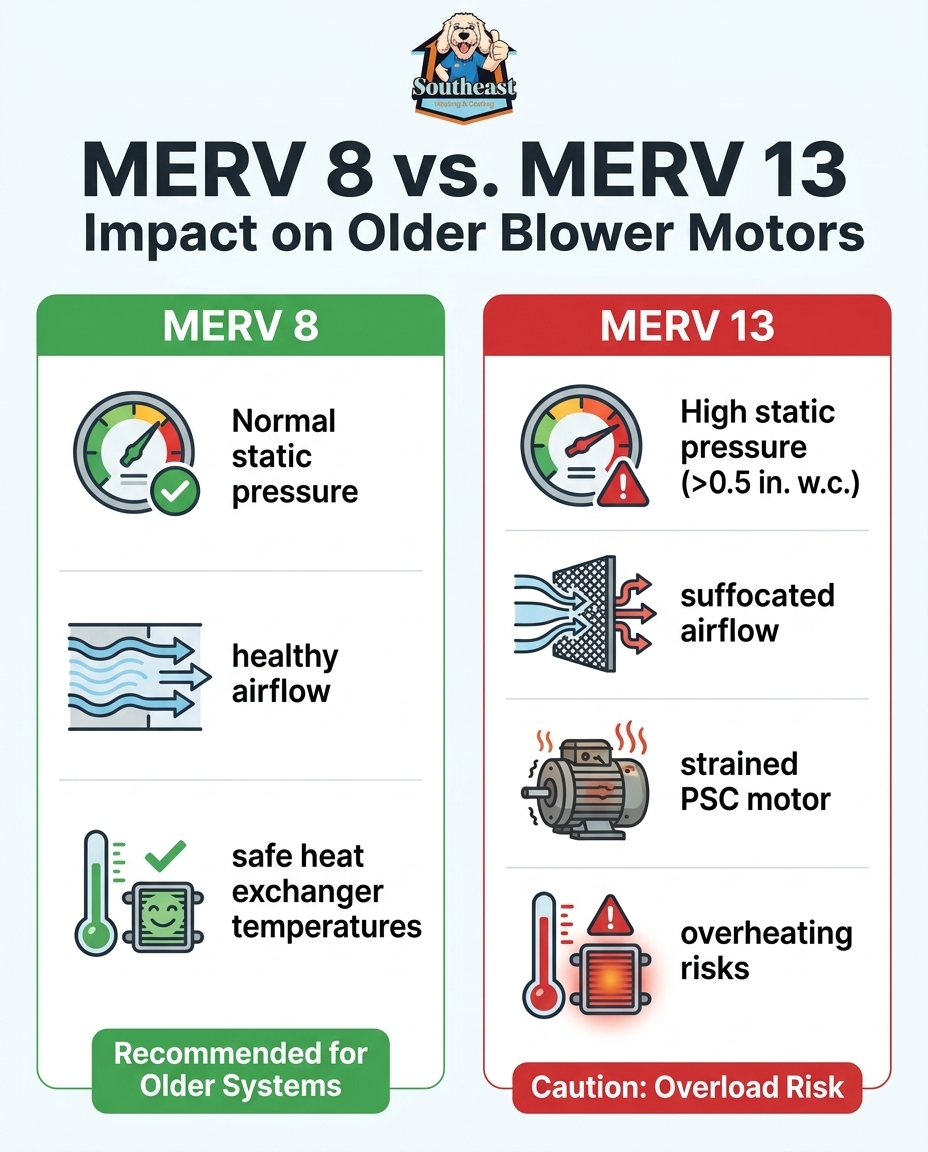
When we look at the equipment installed throughout older Buford residential neighborhoods, the vast majority of these systems rely on Permanent Split Capacitor (PSC) blower motors. These older, single-speed motors were typically designed to operate against a maximum external static pressure of about 0.5 inches of water column (in. w.c.). This means the motor can only push and pull air effectively if the total resistance in the ductwork stays below that threshold.
A standard MERV 8 filter might add 0.1 to 0.15 in. w.c. of resistance, leaving plenty of room for the rest of the ductwork. A dense MERV 13 filter, however, can easily add 0.25 to 0.3 in. w.c. of resistance all by itself. When you add that to the natural resistance of the ductwork and the coils, the total static pressure skyrockets past the 0.5 limit. The filter acts less like an air purifier and more like a piece of cardboard blocking the return vent. If you are relying on older residential heating units to keep your family warm, respecting these original airflow design limits is non-negotiable.
Why PSC Motors Fail Under Pressure
Modern HVAC systems use Electronically Commutated Motors (ECM), which are variable-speed. If an ECM senses a dense filter blocking the air, it can automatically ramp up its RPMs, consuming more electricity to force air through the restriction. While this uses more energy, the motor can usually adapt. PSC motors do not have this ability.
A single-speed PSC motor is a "dumb" motor—it spins at one speed, regardless of the resistance it faces. When a MERV 13 filter chokes off the return air, the blower wheel spins in a partial vacuum. Because it isn't moving enough air, the motor loses its natural cooling mechanism (the air flowing over the motor itself). This causes intense thermal strain. The electrical windings inside the motor overheat, the bearings wear out prematurely, and eventually, the motor burns out completely. What started as a well-intentioned attempt to improve indoor air quality ends in a catastrophic mechanical failure.
The Domino Effect: Suffocated Furnaces and Overheating Risks
When an older system is starved of air, the damage doesn't stop at the blower motor. A suffocated system triggers a dangerous cascade of failures, particularly during the heating season. Heating systems require a massive, continuous volume of cool return air to absorb the heat generated by the burners. When you restrict that airflow, the heat has nowhere to go.
During a mid-fall pre-winter heating startup, a restrictive filter will cause the following sequence of events:
1. Restricted Return Air: The dense MERV 13 media severely limits the volume of air the blower can pull from the house into the furnace cabinet.
2. Poor Airflow Across the Heat Exchanger: Because less air is entering the system, there is an inadequate volume of air blowing over the metal heat exchanger. The heat exchanger continues to absorb heat from the gas burners, but there is no air to carry that heat away into your ductwork.
3. Rapid Overheating: Without sufficient airflow to cool it down, the metal heat exchanger rapidly spikes in temperature, far exceeding its safe operating limits.
4. The High-Limit Switch Trips: To prevent a fire or a cracked heat exchanger, a safety device called the high-limit switch detects the dangerous temperature and immediately shuts down the furnace burners.
5. Short-Cycling and Lockout: The blower continues to run to cool the furnace down. Once cooled, the furnace tries to fire up again, only to overheat and shut down minutes later. This constant on-and-off process, known as short-cycling, eventually causes the system to lock out entirely, leaving you with a no-heat emergency.
Homeowners often notice this problem first at the supply registers. If you hold your hand over a vent and feel a weak, anemic stream of air, the culprit is rarely a broken fan—it is usually a suffocated return. The restrictive filter at the intake is directly responsible for the poor airflow issues noticed at the supply vents throughout the house.
Navigating Buford's Fall Temperature Swings with Proper Airflow
The mechanical risks of restrictive filters are amplified by the specific climate challenges we face in this region. Mid-fall in Buford is notorious for unpredictable temperature swings. We frequently experience weeks where the afternoons are warm enough to require air conditioning, but the nights drop into the low 40s, demanding reliable furnace heat. These massive daily temperature fluctuations force HVAC systems to cycle frequently, shifting back and forth between cooling and heating modes.
This frequent cycling puts an enormous amount of stress on an already strained blower motor. If a MERV 13 filter is installed, the system is fighting an uphill battle twice a day. During a warm afternoon, the restricted airflow prevents enough warm indoor air from passing over the indoor evaporator coil. Without that heat, the refrigerant inside the coil drops below freezing, causing the condensation on the coil to turn to solid ice. A frozen coil completely blocks all airflow and can severely damage the outdoor compressor.
Then, when the sun goes down and the thermostat switches to heating, that same restricted airflow causes the furnace to overheat and trip its safety switches. Whether the system is running air conditioning systems during the day or heating at night, unrestricted airflow is the single most critical factor in preventing breakdowns. Furthermore, the legacy ductwork found in many older Buford residential neighborhoods is already prone to natural airflow challenges due to its age and design. Adding a highly restrictive filter to an already marginal duct system guarantees performance problems during our transitional fall weather.
Why Our Technicians Trust MERV 8 for Aging Local Systems
When it comes to protecting the longevity of your HVAC equipment, we rely on field-tested reality, not hardware store marketing. What our techs see on a daily basis is clear: we frequently diagnose "broken" furnaces that are entirely mechanically sound, but have been choked into submission by a premium, dense air filter. In our experience, simply removing a clogged MERV 13 filter and replacing it with a fresh MERV 8 filter is often the only repair needed to restore a system to full functionality.
Our strong preference for MERV 8 filters is rooted in finding the optimal balance between system safety and indoor air quality. A MERV 8 filter is highly effective at capturing the vast majority of airborne irritants that homeowners care about. It traps dust mites, pollen, mold spores, and pet dander with ease. Most importantly, it does this without starving the blower motor of the air it desperately needs to operate safely.
It is also important to note that a dirty filter becomes exponentially more restrictive. A MERV 13 filter that has been in place for two months is drastically more suffocating than a brand new one. We advise homeowners that replacing a less restrictive MERV 8 filter regularly (every 30 to 60 days) provides far better overall air quality and system health than leaving a rapidly clogging MERV 13 filter in place for a whole season. When we evaluate the MERV 8 vs MERV 13 airflow restriction in real-world conditions, MERV 8 is undeniably the safest, most reliable choice for fall maintenance on older units.
Frequently Asked Questions About Air Filters and Older HVAC Units
Can a MERV 13 filter damage my HVAC?
Yes, in older systems, a MERV 13 filter can cause significant mechanical damage. The dense media creates high static pressure, which forces the blower motor to work much harder to pull air through the return. Over time, this intense strain can cause older single-speed motors to overheat, wear out their bearings, and fail prematurely. Additionally, the lack of airflow can cause the furnace heat exchanger to overheat and crack.
Is MERV 8 good enough for a home?
Absolutely. For the vast majority of residential homes, MERV 8 is the ideal rating. It effectively traps common household allergens like dust, pollen, pet dander, and mold spores while maintaining healthy, unrestricted airflow. Unless you have severe respiratory issues that require hospital-grade filtration, a MERV 8 filter changed regularly will keep your indoor air fresh and clean without risking damage to your HVAC equipment.
Does MERV 13 restrict airflow too much?
It depends entirely on the age and design of your HVAC equipment. For modern systems equipped with variable-speed ECM blowers and oversized return ductwork, a MERV 13 filter may be perfectly fine. However, for older single-speed PSC motors, a MERV 13 filter typically restricts airflow well beyond the system's original design limits. This restriction acts like a physical blockage, starving the system of the air it needs to heat and cool your home.
What MERV rating is best for older HVAC systems?
MERV 8 is widely considered the sweet spot for older residential systems. It provides a significant upgrade over cheap, fiberglass "rock catcher" filters (which are usually MERV 1 to 4) but stops short of the dense, restrictive media found in MERV 11 or 13 filters. MERV 8 balances adequate filtration for your family's health with the necessary airflow required to keep aging blower motors and heat exchangers operating safely.
Will an overly restrictive filter cause my furnace to overheat?
Yes, an overly restrictive filter is one of the most common causes of furnace overheating. A furnace relies on a steady stream of cool return air to absorb the heat generated by the burners. When a dense filter restricts that return air, the heat exchanger cannot cool down properly. This causes internal temperatures to spike rapidly, often tripping the high-limit safety switch and shutting the furnace down to prevent a fire.
Protect Your Blower Motor and Enjoy Reliable Fall Comfort
Understanding the technical realities of filter airflow is one of the easiest ways to save your older HVAC system from costly, preventable winter breakdowns. While the marketing on the filter box might promise a cleaner home, forcing a MERV 13 filter into an aging system is a recipe for suffocation, overheating, and mechanical failure.
Choosing a MERV 8 filter is a smart, protective measure that ensures your specific equipment can breathe freely while still capturing the dust and pollen that trigger allergies. If you are unsure about your system's static pressure or want to ensure your ductwork is flowing properly before the freezing weather arrives, we highly encourage having your airflow evaluated during your routine HVAC maintenance. A quick tune-up and the right filter can ensure your blower motor stays healthy and your home stays comfortable all season long.
Related Blogs
Customer Testimonials


Financing



Latest Blogs
Why We Recommend MERV 8 Over MERV 13 Filters for Older Buford Residential Systems
Decoding the Loud Clanking Sound When Your Gas Furnace First Ignites in October

The Truth About Closing Vents in Unused Guest Rooms to Save on Heating Costs